We need your help to keep this website free. You can

I don’t know about you, but my patience for bad design is completely gone these days.
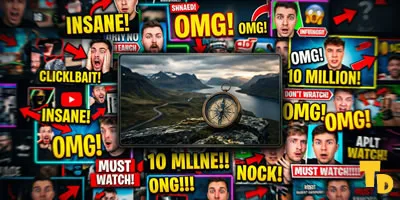
If an artist hopes that I will take the time to watch his 20-minute-long video essay or software tutorial, then the presentation needs to convince me that this is worth my while. If the thumbnail is something that was sloppily thrown together using MS Paint with all sorts of neon borders and emojis flying around, then I am going straight to the next video.

We are seeing a massive shift in viewer expectations right now. The cheap, loud aesthetics are dying out. Instead, they are being replaced by what I like to call the “Movie Poster Look.”
And if you want to push your YouTube CTR (Click-Through Rate) into the double digits this year, you really need to understand how to pull this off.
The Direct Result of the Long-Form Video Comeback
This entire aesthetic shift didn’t just happen out of nowhere. It is the direct consequence of a massive change in how platforms treat watch time.
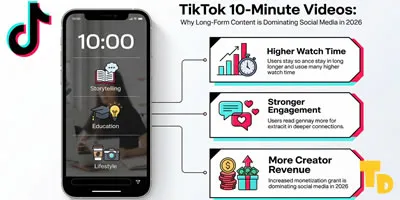
As we broke down recently in our deep dive on why 10-minute, long-form videos are dominating social media in 2026, the internet is pivoting away from hyper-caffeinated, 15-second clips. Audiences are hungry for actual substance. They want mini-documentaries. They want a thorough analysis.
But here is the catch. You cannot market a 30-minute masterpiece the same way you market a 10-second meme.
When a Hollywood studio releases a psychological thriller, they don’t market it with a chaotic, text-heavy graphic. They release a meticulously crafted poster. It has a mood. It has depth. It makes a promise to the audience about the quality of the production they are about to watch. Creators are finally adopting this same mindset for their long-form video thumbnails.
Decoding the “Movie Poster” Thumbnail Design
So, what actually makes a thumbnail look like a movie poster instead of a standard YouTube graphic? It really comes down to ditching the “flat” look.
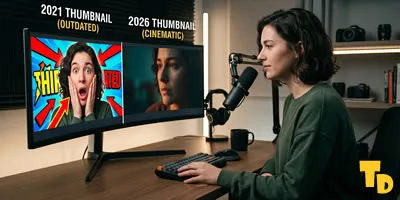
For many years, designers would take a photograph of themselves and frame it with a thick white line before putting it onto a blurry background. This was a totally two-dimensional poster.
Depth is central to the poster style. Here, you need to have images in the foreground (blurred leaves, microphones, etc.), a focused mid-ground image, and a vast background scene. The goal is not merely to join these elements together, but to create an entirely new image. You need to make people perceive your poster as a window opening onto another world rather than a mere piece of paper glued to a computer bulletin board.
Color Grading is Your New Clickbait
If you aren’t paying attention to your color palettes, you are leaving views on the table. The colors you choose dictate the emotional response of the viewer before they even read your title.
Right now, we are seeing two massive color trends dominating the high-CTR movie poster look:
- Cyberpunk Blues and Neons: If you are making tech commentary, finance deep-dives, or talking about AI, this is your goldmine. Deep, moody blues contrasted with harsh, neon orange or magenta rim lighting. It immediately signals that the topic is futuristic, serious, or slightly chaotic.
- A24-Style Earth Tones: Think warm, gritty, film-grain aesthetics. Muted greens, deep browns, and warm tungsten lighting. This works unbelievably well for lifestyle video essays, history breakdowns, or personal storytelling. It feels grounded, nostalgic, and incredibly authentic.
You don’t need a massive studio to do this. A simple color grade adjustment in Lightroom or an AI-generated background replacement can completely shift a boring room into a cinematic set.
Stop Trying to “Hack” the Algorithm
I see so many people stressing over the exact placement of a red arrow or trying to trick the algorithm with bizarre graphic elements.
Stop doing that.
The platforms have evolved. The algorithm follows the audience, and the audience wants quality. When you design a thumbnail that legitimately looks like a piece of promotional art for a Netflix documentary, you instantly bypass the “spam filter” in the viewer’s brain.
Treat your long-form content with the respect it deserves. Spend the extra hour on the packaging. Choose a color palette that tells a story, compose a shot with actual depth, and watch how quickly a professional, movie-poster aesthetic completely transforms your organic search traffic.